
The Mock Server Is the First Environment in Your Pipeline
Your deployment pipeline has staging and production. It's missing the environment where AI agents do 80% of the actual development work.
This is Part 3 of a series on mock servers and AI development. Part 1 covers why AI agents need local service infrastructure. Part 2 covers digital twins and multi-worktree parallel development.
Your deployment pipeline probably looks something like this: dev environment, staging, production. Maybe you have a QA environment in between. Maybe “dev” just means “your laptop.”
Here’s the problem with that pipeline: it was designed for humans who develop code carefully and methodically. AI agents develop code quickly and iteratively. The pipeline as designed can’t absorb the pace, and the result is either wasted money or wasted time — usually both.
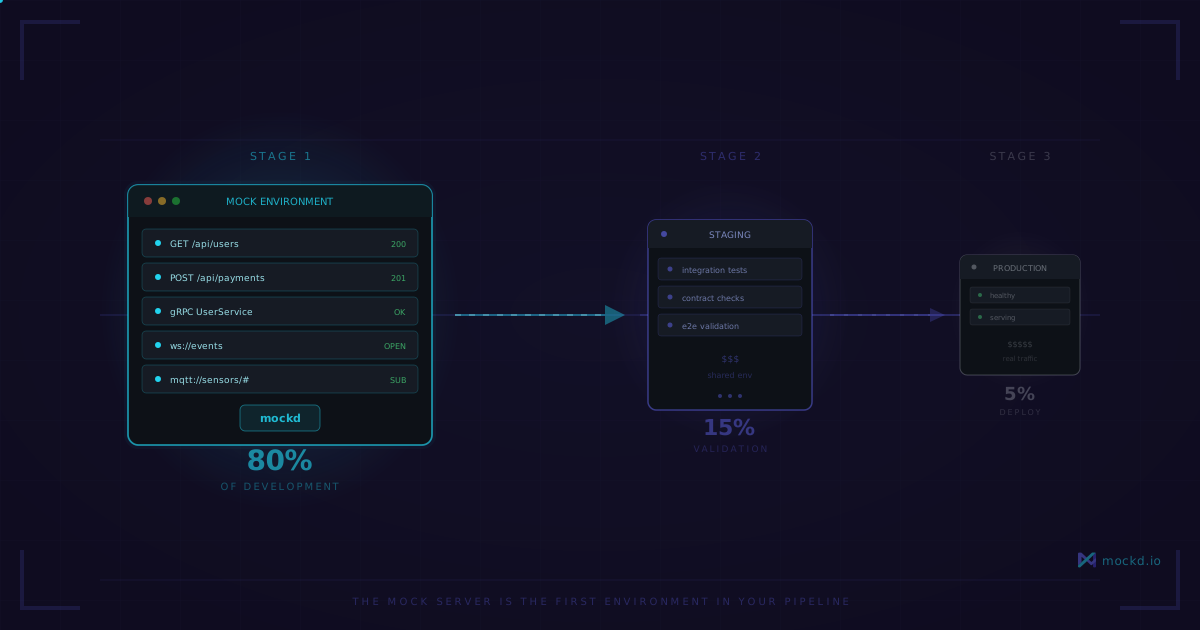
There’s a missing environment. It sits before staging, it costs nothing to run, and it’s where 80% of development should actually happen. It’s a mock environment, and the teams that don’t have one are burning money on staging or blocking their agents on infrastructure they don’t control.
The staging environment was never a development tool
Staging was designed for integration validation — confirming that code which works in isolation also works when connected to real dependencies. One last check before production.
But at most companies, staging has quietly become the primary development environment. Developers and their AI agents build features against staging because they need real services to develop against, and staging is the only place those services exist.
This creates compounding problems:
Cost. A microservices architecture with 20 services, each with compute, a database, and a message queue, easily runs $10,000–$50,000 per month in staging infrastructure. That cost scales linearly with the number of parallel staging environments you maintain. Most teams maintain one and share it.
Contention. Twenty developers building against the same staging environment means twenty people’s test data coexisting in the same databases, twenty people’s mock users in the same auth system, twenty people’s feature branches potentially deployed to the same services. One developer’s broken deployment blocks three others. Shared staging is shared suffering.
Flakiness. Staging services go down. Not because they’re poorly built, but because they’re staging — lower priority, fewer resources, less monitoring. A single staging service at 95% availability sounds fine. But with 8 dependent services, the probability that all 8 are simultaneously healthy is 0.95^8 = 66%. A third of the time, something in your staging dependency chain is broken, and nobody knows which third it’ll be today.
Latency. Every call to a staging service adds network round-trip time to the development loop. 50ms per call, 150 calls per session, that’s 7.5 seconds of pure network wait per development cycle. Multiply by the number of cycles an AI agent runs in an afternoon and you start to see where the day went.
What the best engineering teams built (and what it cost)
The largest engineering organizations recognized this problem years ago and built solutions. The pattern they converged on is remarkably consistent across companies.
Airbnb built an API Data Factory: schema-validated YAML fixture files for every service, shared between teams, consumed by a test harness that mocks all external boundaries. Engineers develop and test in complete isolation from real dependencies. Their “shallow integration test” approach — deploy the service under test, mock everything else — is now their default CI strategy.
Uber built SLATE: a platform that provisions ephemeral environments with the service under test alongside mocked dependencies. Each pull request gets its own isolated environment with fresh state.
Netflix leaned even harder into the thesis: at their scale (1,000+ microservices), they concluded that maintaining a mock universe was impractical. Instead, they invested in production canary analysis and chaos engineering. But for individual service testing, they still use fixture-based mocking at the team level.
Spotify uses Backstage as a developer portal that catalogs every service’s API definition. Those definitions become the source of truth for generating mocks. The platform team maintains the infrastructure; product teams maintain their own mock definitions.
The common thread: mocking becomes a platform concern at scale. It’s not something individual developers cobble together with WireMock configs and shell scripts. It’s infrastructure that a platform team provides and product teams consume.
The catch: these systems cost 6–12 months of dedicated engineering time to build, require a team to maintain, and are tightly coupled to each company’s internal infrastructure. Nobody publishes a package you can go install to get Airbnb’s mocking setup.
Mock as the first environment
The pipeline should have three environments, not two:
Mock (local/CI)  -->  Staging  -->  Production
     80%               15%          5%
  development       validation   deployment
The mock environment is where active development happens. It’s:
- Free — runs on your laptop or CI runner, zero cloud cost
- Fast — sub-millisecond responses, no network hop
- Isolated — each developer or agent gets their own instance
- Controlled — you configure exactly what it returns, including errors and edge cases
- Always available — doesn’t depend on anyone else’s infrastructure or schedule
Staging becomes what it was always supposed to be: a validation gate. “The code works against mocks — now verify it works against real services.” This step should take minutes, not hours or days. If code developed against a well-configured mock environment doesn’t work in staging, that’s a signal to improve the mock, not to spend more time in staging.
AI agents change the math by an order of magnitude
Without AI agents, the case for mock environments was solid but not urgent. A developer hits staging 30 times during a feature build. The cost and latency are annoying but manageable. You can live with it.
With AI agents, the numbers shift dramatically.
An agent doing iterative development makes 100–500 API calls per feature. It tests aggressively, explores edge cases, retries on failure, regenerates code, tests again. Against staging:
- 500 calls at 50ms network latency = 25 seconds of pure network wait per feature
- Rate limit encounters = agent confusion + wasted tokens diagnosing non-errors
- Staging downtime = agent blocked, developer blocked, zero progress
- Cross-contamination = agent’s test data interfering with other developers’ work
Against local mocks:
- 500 calls at sub-millisecond latency = effectively instant
- No rate limits = no confusion
- No downtime = no blocking
- Full isolation = no contamination
The argument for mock environments was always about developer productivity. AI agents put a 10x multiplier on that argument. Every friction point that was tolerable for human development speed becomes a serious bottleneck at agent development speed.
The team-scale pattern
Here’s how this actually works for a team of 20 engineers running AI agents:
Each team maintains mock definitions for the services they own. The payment team publishes mock definitions for the payment API. The user team publishes definitions for the user API. These definitions live alongside the service’s API spec in the service repo — same repo, same review process, same versioning.
Consumer teams reference those definitions. When the checkout team needs the payment API and the user API, they pull mock definitions from those teams’ published specs and run them locally. Pin to a version. Upgrade when ready.
Each developer gets isolated instances. Developer A runs mockd serving payment and user mocks. Developer B runs a separate instance with the same mocks. No shared state, no coordination required.
CI gets ephemeral instances. Each pull request spins up its own mockd container with the required mock definitions. Tests run in isolation. The container dies when the pipeline finishes.
# GitHub Actions — ephemeral mock environment per PR
services:
  mockd:
    image: ghcr.io/getmockd/mockd:latest
    ports:
      - "4280:4280"
    volumes:
      - ./mocks:/config
    command: ["serve", "--config", "/config/mockd.yaml", "--no-auth"]

steps:
  - name: Run tests
    env:
      PAYMENT_API: http://mockd:4280/payment
      USER_API: http://mockd:4280/users
    run: go test ./...
The mock server starts in under a second. Tests run against it. The server dies when the pipeline finishes. No infrastructure persists between runs. No state leaks between PRs. No platform team gets paged because a mock environment is unhealthy.
The mock catalog
At scale, mock definitions become a shared organizational resource. The pattern looks like dependency management — because that’s what it is:
mock-catalog/
  payment-service/
    v3.2.1/
      mockd.yaml        # Mock definitions for payment API v3.2.1
      openapi.yaml      # Source spec (for verification)
  user-service/
    v2.1.0/
      mockd.yaml
      openapi.yaml
  notification-service/
    v1.4.0/
      mockd.yaml
      openapi.yaml
Teams publish mock definitions alongside their API specs. Consumer teams pin to versions, just like they pin library dependencies. When the payment team releases v3.3.0 with new endpoints, they publish updated mock definitions. Consumer teams upgrade on their own schedule.
This is the same model as npm packages or Go modules, applied to service behavior instead of code. Version it, publish it, consume it, pin it.
The organizations that have built this internally — Airbnb’s API Data Factory, Uber’s test doubles registry — spent significant engineering effort on what is fundamentally a package management problem for mocks. The tooling to do this with off-the-shelf open source is catching up.
MCP closes the automation loop
The last piece: AI agents shouldn’t need humans to set up their mock environment.
When a developer says “build the checkout flow,” their agent should be able to:
- Read the project’s dependency list (which services this code calls)
- Pull mock definitions from the catalog or import from API specs
- Start a local mock server with those definitions
- Begin development
With MCP-enabled mock servers, steps 2 through 4 are tool calls the agent makes directly. No human writes YAML. No human runs commands. The agent provisions its own development infrastructure in seconds.
Developer: "Build the new checkout flow. It talks to the
            payment API and the inventory API."

Agent:
  1. Finds payment API OpenAPI spec in the project dependencies
  2. Calls mockd MCP: import_mocks(format: "openapi", content: ...)
  3. Finds inventory API spec
  4. Calls mockd MCP: import_mocks(format: "openapi", content: ...)
  5. Verifies both sets of endpoints respond correctly
  6. Begins writing checkout code against localhost:4280
The developer’s job: describe what to build and review the output. The agent handles everything else, including provisioning the infrastructure it needs to build against. The mock server isn’t a tool the developer configures for the agent — it’s a tool the agent configures for itself.
Where this is heading
The trajectory from here is pretty clear:
Today: Developers manually configure local mock servers. Some AI agents manage mocks via MCP. Multi-worktree patterns are emerging but not standardized.
Near-term: Mock definitions are shared in team catalogs and versioned alongside API specs. AI agents self-provision from catalogs. Mock environments are ephemeral and per-PR. The mock catalog becomes a first-class dependency management surface.
Medium-term: Mock definitions are auto-generated from production traffic using record-and-replay. Twins are validated against real services continuously. Drift detection alerts teams when a twin’s behavior diverges from reality.
Long-term: AI agents generate realistic service twins from a combination of API specs, documentation, and production traffic samples. The distinction between “mock” and “development environment” dissolves. The mock IS the first environment, and it’s maintained automatically.
We’re early in this shift. The tools are catching up to the workflow. But the direction is clear: the teams that treat mock infrastructure as a first-class concern — the way they treat CI/CD, observability, and deployment — will move faster than the teams that treat mocking as an afterthought someone does in a test file.
The series
This was the final part of a three-post series on mock servers and AI development:
- Part 1: Your AI Coding Agent Needs a Dev Environment Too — Why AI agents need local service infrastructure and the cost of not having it.
- Part 2: Digital Twins, Not Mock Responses — Why agents need stateful service replicas, and the multi-worktree parallel development pattern.
- Part 3: This post — Mock environments as a deployment pipeline stage, shared mock catalogs, and the enterprise perspective.
mockd is the tool I built to make this real. Single binary, 7 protocols (HTTP, gRPC, GraphQL, WebSocket, MQTT, SSE, SOAP), built-in MCP server for AI agent integration, and stateful resources for digital twin behavior. Apache 2.0 licensed.
Learn more
- Quickstart guide — install mockd and create your first mock in under 60 seconds
- Enterprise features — RBAC, audit logging, mTLS, and team collaboration
- Pricing — free tier with unlimited endpoints and calls, team and enterprise plans
- Mockd vs Microcks — how Mockd compares to the CNCF-backed mocking platform
Links
- GitHub: github.com/getmockd/mockd (Apache 2.0)
- Docs: docs.mockd.io
- Install:
brew install getmockd/tap/mockdorcurl -fsSL https://get.mockd.io | sh
Try mockd
Multi-protocol API mock server. HTTP, gRPC, GraphQL, WebSocket, MQTT, SSE, SOAP.