
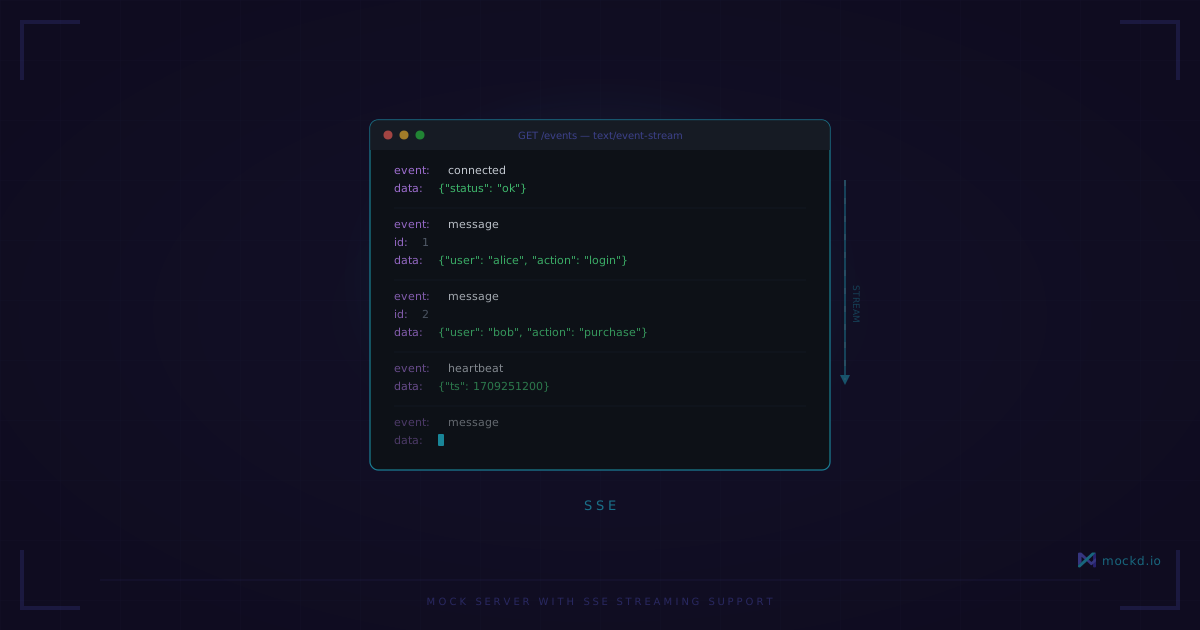
Mock Server with SSE Streaming Support
Set up a mock SSE endpoint with typed events, timed delivery, and lifecycle control. Test EventSource clients against real server-sent event streams. No code required.
Server-Sent Events are one of those technologies that’s simple in concept and annoying in practice. The spec is elegant — the server sends text/event-stream data over a regular HTTP connection. Your browser reconnects automatically if the connection drops. No WebSocket upgrade, no special protocol.
But testing SSE is a pain. You need a server that holds connections open and sends events over time. Most mock servers don’t do this. They return a response and close the connection. An SSE stream, by definition, doesn’t close until you tell it to.
A mock SSE endpoint
mockd add http --path /events --sse
  --sse-event 'message:{"text": "hello"}'
  --sse-event 'message:{"text": "world"}'
That creates an SSE endpoint on http://localhost:4280/events. Connect with curl to see the stream:
curl -N http://localhost:4280/eventsretry:3000
event:message
data:{"text":"hello"}
event:message
data:{"text":"world"}
That’s a valid SSE stream. The retry:3000 tells the browser to reconnect after 3 seconds if the connection drops. Each event has a type (message) and data (your JSON). A blank line separates events — that’s how SSE works.
Typed events
SSE events have a type field that clients can filter on. This is useful when one endpoint streams different kinds of data:
# mockd.yaml
version: "1.0"

mocks:
  - name: Stock Prices
    type: http
    http:
      matcher:
        method: GET
        path: /stock/stream
      sse:
        events:
          - type: price
            id: "1"
            data:
              symbol: AAPL
              price: 178.50
          - type: price
            id: "2"
            data:
              symbol: GOOG
              price: 141.20
          - type: alert
            id: "3"
            data:
              message: "Market closing in 30 minutes"
        timing:
          fixedDelay: 500
        lifecycle:
          maxEvents: 3
mockd serve --config mockd.yamlNow curl it:
curl -N http://localhost:4280/stock/streamretry:3000
event:price
id:1
data:{"price":178.5,"symbol":"AAPL"}
event:price
id:2
data:{"price":141.2,"symbol":"GOOG"}
event:alert
id:3
data:{"message":"Market closing in 30 minutes"}
On the client side, you listen for specific event types:
const es = new EventSource("/stock/stream");

es.addEventListener("price", (e) => {
  const data = JSON.parse(e.data);
  console.log(`${data.symbol}: $${data.price}`);
});

es.addEventListener("alert", (e) => {
  const data = JSON.parse(e.data);
  console.log(`Alert: ${data.message}`);
});
The id field enables resumption. If the connection drops, the browser sends Last-Event-ID: 3 on reconnect, so the server knows where the client left off. Not all mock scenarios need this, but it’s there when you do.
Why is SSE testing hard?
The fundamental issue: SSE is a long-lived connection. Most testing approaches assume request-response semantics — you send a request, you get a response, you’re done. SSE doesn’t work that way.
Here’s what “testing SSE” usually looks like in practice:
Option 1: Mock the EventSource constructor. You override EventSource in your test environment and manually fire events. This tests your event handling code but not the actual connection behavior.
Option 2: Write a test server. You write a small Express/Fastify server that sends text/event-stream responses. This works, but now you’re maintaining a test server alongside your tests.
Option 3: Skip it. Test the rest of the app and hope the SSE part works in staging.
What I wanted was a middle ground: a server that sends real SSE events, is configurable without code, and dies when I don’t need it anymore.
Timing control
The timing.fixedDelay field controls how many milliseconds between events. This matters for testing:
- Fast (10ms): When you just want to verify your client handles multiple events. Tests run fast.
- Slow (1000ms+): When you’re testing UI behavior — loading states, progressive rendering, or how your dashboard handles a stream of updates.
timing:
  fixedDelay: 1000  # one event per second
Finite vs infinite streams
By default, mockd sends all events in the list and then closes the connection. The lifecycle.maxEvents field controls how many total events to send.
For testing reconnection logic, you might want the stream to close after a few events so the EventSource triggers its reconnect behavior:
lifecycle:
  maxEvents: 3  # close after 3 events
Combining SSE with other mocks
This is where mockd being multi-protocol helps. Most real-time features combine SSE with REST endpoints:
version: "1.0"

mocks:
  # REST endpoint to fetch initial data
  - name: Get Orders
    type: http
    http:
      matcher:
        method: GET
        path: /api/orders
      response:
        statusCode: 200
        body: '[{"id": "order_1", "status": "pending"}]'

  # SSE endpoint for real-time updates
  - name: Order Updates
    type: http
    http:
      matcher:
        method: GET
        path: /api/orders/stream
      sse:
        events:
          - type: status_change
            data:
              orderId: order_1
              status: processing
          - type: status_change
            data:
              orderId: order_1
              status: shipped
        timing:
          fixedDelay: 2000
Your frontend fetches /api/orders on load, then opens an EventSource on /api/orders/stream for live updates. Both endpoints are served by the same mockd instance.
Limitations
- No
Last-Event-IDresumption. The mock server doesn’t track where a disconnected client left off. It always starts from the beginning. Fine for testing; not a real event store. - No conditional events. You can’t send different events based on query parameters or headers in the SSE stream (though you can use separate paths with different matchers).
- No infinite generators yet. If you need a stream that runs forever with changing data (like a simulated stock ticker), you’re limited to a finite event list with repeat. A proper generator system is on the roadmap.
Want one of these? Open an issue — feature requests directly shape what gets built next. And if mockd saved you from writing a test SSE server, a star on GitHub helps other developers find it.
Learn more
- SSE protocol overview — all SSE mocking features including typed events, timing control, and lifecycle management
- Mockd vs MSW — MSW doesn’t support SSE streaming. Mockd handles long-lived connections natively.
- Mockd vs WireMock — WireMock doesn’t support SSE. Mockd does, alongside 6 other protocols.
- All 7 supported protocols — HTTP, gRPC, GraphQL, WebSocket, MQTT, SSE, SOAP
Links
- GitHub: github.com/getmockd/mockd (Apache 2.0)
- SSE docs: docs.mockd.io/protocols/sse
- Install:
brew install getmockd/tap/mockdorcurl -fsSL https://get.mockd.io | sh
Try mockd
Multi-protocol API mock server. HTTP, gRPC, GraphQL, WebSocket, MQTT, SSE, SOAP.