
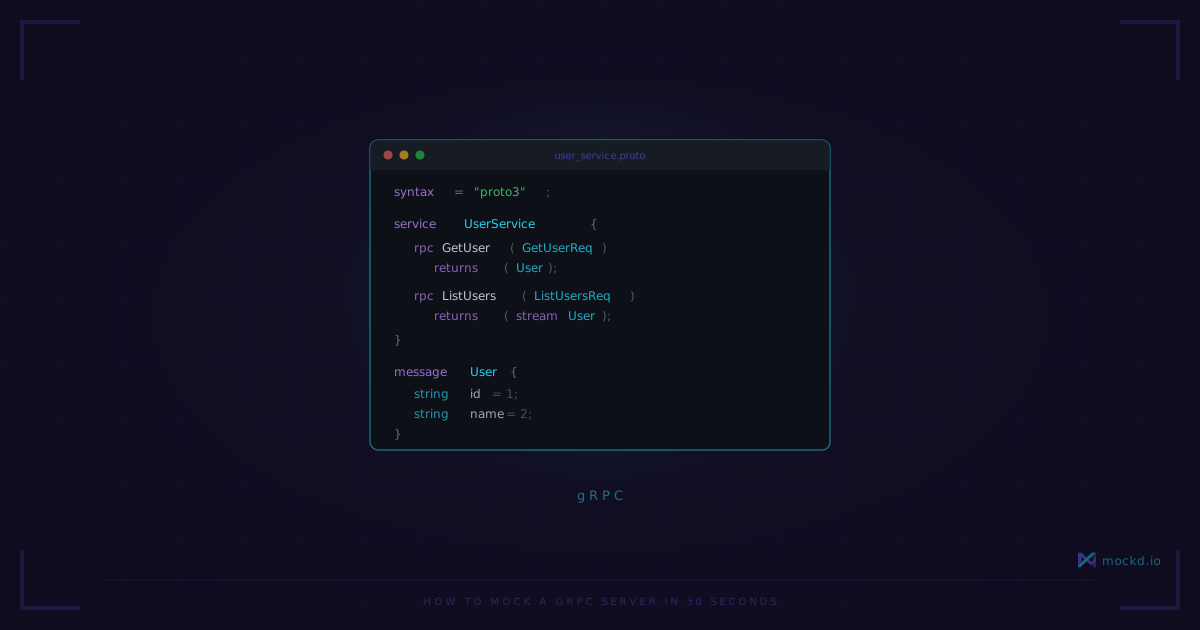
How to Mock a gRPC Server in 30 Seconds
Set up a gRPC mock server without protoc, code generation, or Java. One command, one proto file, real gRPC responses. Works with grpcurl and any client.
I spent a solid afternoon last year trying to set up a mock gRPC server for integration tests. The options were: write a full Go server that implements the interface, spin up WireMock with the gRPC extension and figure out the Java classpath situation, or… just not test that code path.
I picked option three. Not proud of it.
When I built mockd, gRPC was the protocol I wanted to get right. Here’s what “get right” looks like:
The 30-second version
Install mockd:
# macOS
brew install getmockd/tap/mockd

# Linux / Windows
curl -fsSL https://get.mockd.io | sh
Create a proto file. You probably already have one — that’s the whole point. I’ll use a simple greeter:
// greeter.proto
syntax = "proto3";

package helloworld;

service Greeter {
  rpc SayHello (HelloRequest) returns (HelloReply) {}
}

message HelloRequest {
  string name = 1;
}

message HelloReply {
  string message = 1;
}
Start the mock server:
mockd add grpc
  --proto greeter.proto
  --service helloworld.Greeter
  --rpc-method SayHello
  --response '{"message": "Hello, World!"}'
That’s it. You now have a gRPC server on port 50051 that responds to SayHello. Test it:
grpcurl -plaintext -d '{"name": "Alice"}'
  localhost:50051 helloworld.Greeter/SayHello
{
"message": "Hello, World!"
}30 seconds. No Java. No code generation. No writing a server.
Why this is hard with other tools
The standard approach to mocking gRPC in Go looks something like this:
type mockGreeterServer struct {
    pb.UnimplementedGreeterServer
}

func (s *mockGreeterServer) SayHello(ctx context.Context, req *pb.HelloRequest) (*pb.HelloReply, error) {
    return &pb.HelloReply{Message: "Hello, " + req.Name}, nil
}

func TestSomething(t *testing.T) {
    lis, _ := net.Listen("tcp", ":0")
    s := grpc.NewServer()
    pb.RegisterGreeterServer(s, &mockGreeterServer{})
    go s.Serve(lis)
    defer s.Stop()
    // ... now write your test
}
That’s fine for one service. It’s less fine when you have twelve services and you need different responses for different test scenarios. You end up with a mock_servers_test.go file that’s 400 lines of boilerplate.
WireMock has a gRPC extension, but it requires the Java runtime, the WireMock standalone JAR, and the gRPC extension JAR. The setup instructions are a page long.
The YAML version
For more complex setups, a config file is cleaner than CLI flags:
# mockd.yaml
version: "1.0"

mocks:
  - name: Greeter Service
    type: grpc
    grpc:
      port: 50051
      protoFile: ./greeter.proto
      reflection: true
      services:
        helloworld.Greeter:
          methods:
            SayHello:
              response:
                message: "Hello, {{request.body.name}}!"
mockd serve --config mockd.yamlA few things worth noting:
reflection: true enables gRPC server reflection. This means you can use grpcurl without passing the proto file on the client side — the mock server tells the client what services and methods are available. Useful for debugging:
grpcurl -plaintext localhost:50051 list
# grpc.health.v1.Health
# grpc.reflection.v1.ServerReflection
# grpc.reflection.v1alpha.ServerReflection
# helloworld.Greeter
{{request.body.name}} pulls the name field from the incoming request and uses it in the response. So grpcurl -d '{"name": "Alice"}' localhost:50051 helloworld.Greeter/SayHello returns {"message": "Hello, Alice!"}.
Server streaming
mockd handles all four gRPC patterns: unary, server streaming, client streaming, and bidirectional. Here’s server streaming — you just supply a list of responses instead of a single one:
services:
  helloworld.Greeter:
    methods:
      SayHelloStream:
        responses:
          - message: "Hello! (1/3)"
          - message: "Hello again! (2/3)"
          - message: "One more time! (3/3)"
        streamDelay: "500ms"
Each response is sent as a separate stream message with a 500ms delay between them. grpcurl shows them arriving one at a time:
grpcurl -plaintext -d '{"name": "World"}'
  localhost:50051 helloworld.Greeter/SayHelloStream
# {  "message": "Hello! (1/3)" }
# {  "message": "Hello again! (2/3)" }
# {  "message": "One more time! (3/3)" }
Dynamic response data
mockd has template functions you can use inside response fields. The {{request.body.name}} template we saw earlier is one example. Others:
SayHello:
  response:
    message: "Hello {{request.body.name}}, your request ID is {{uuid}}"
{{uuid}} generates a unique ID on each call. {{now}} gives you an ISO-8601 timestamp. There are about 34 faker functions available — {{faker.email}}, {{faker.name}}, {{faker.ipv4}}, etc.
One thing to know: your response fields must match the proto message definition. If HelloReply only has a message field, you can’t add timestamp or requestId to the response — the proto schema defines the shape. Templates go inside the field values, not as new fields.
Using it in tests
The pattern I’ve settled on: start mockd in the background, run tests, stop it.
# Start in background
mockd serve --config mockd.yaml --detach

# Run tests (your gRPC client connects to localhost:50051)
go test ./...

# Stop
mockd stop
Or in Docker Compose:
services:
  mockd:
    image: ghcr.io/getmockd/mockd:latest
    volumes:
      - ./mockd.yaml:/config/mockd.yaml
      - ./greeter.proto:/config/greeter.proto
    command: ["serve", "--config", "/config/mockd.yaml", "--no-auth"]
    ports:
      - "50051:50051"
      - "4280:4280"

  tests:
    build: .
    depends_on:
      mockd:
        condition: service_healthy
    environment:
      GRPC_SERVER: mockd:50051
The part where I’m honest about limitations
mockd parses your proto files at startup. It does not generate Go code — it interprets the proto schema dynamically using protobuf descriptors. This means:
- It works with any proto file. You don’t need
protocorprotoc-gen-goinstalled. - It doesn’t validate request payloads against the schema. If you send
{"name": 42}when the proto saysstring name = 1, mockd won’t complain. It’s a mock server, not a contract validator. - Proto imports work, but you need to tell mockd where to find them with
--proto-path.
If you need strict contract validation, you want a different tool. If you need a gRPC server that responds with predictable data so you can test your client code, mockd is probably the fastest way to get there.
If any of these limitations are blockers for you — or if you want something that doesn’t exist yet — open an issue. The roadmap is heavily shaped by what people actually need. And if mockd saved you some time, a star on GitHub helps other developers find it.
Learn more
- gRPC protocol overview — see all gRPC mocking features including streaming, reflection, and proto imports
- Mockd vs WireMock — WireMock requires Java + a gRPC extension JAR. Mockd does it natively in a single binary.
- Mockd vs Microcks — how Mockd’s gRPC support compares to Microcks, including startup time and memory usage
- All 7 supported protocols — HTTP, gRPC, GraphQL, WebSocket, MQTT, SSE, SOAP
Links
- GitHub: github.com/getmockd/mockd (Apache 2.0)
- gRPC docs: docs.mockd.io/protocols/grpc
- Install:
brew install getmockd/tap/mockdorcurl -fsSL https://get.mockd.io | sh
Try mockd
Multi-protocol API mock server. HTTP, gRPC, GraphQL, WebSocket, MQTT, SSE, SOAP.